As traduções são geradas por tradução automática. Em caso de conflito entre o conteúdo da tradução e da versão original em inglês, a versão em inglês prevalecerá.
Crie um manipulador de certificados personalizado para armazenamento seguro
O gerenciamento de certificados de dispositivos é crucial ao integrar o hub de integrações gerenciadas. Embora os certificados sejam armazenados no sistema de arquivos por padrão, você pode criar um manipulador de certificados personalizado para maior segurança e gerenciamento flexível de credenciais.
O SDK de dispositivo final de integrações gerenciadas fornece um manipulador de certificados para proteger a interface de armazenamento que você pode implementar como uma biblioteca de objetos compartilhados (.so). Crie sua implementação de armazenamento seguro para ler e gravar certificados e, em seguida, vincule o arquivo da biblioteca ao HubOnboarding processo em tempo de execução.
Definição e componentes da API
Analise o secure_storage_cert_handler_interface.hpp arquivo a seguir para entender os componentes e os requisitos da API para sua implementação
Definição de API
Conteúdo de secure_storage_cert_hander_interface.hpp
/*
    * Copyright 2024 Amazon.com, Inc. or its affiliates. All rights reserved.
    *
    * AMAZON PROPRIETARY/CONFIDENTIAL
    *
    * You may not use this file except in compliance with the terms and
    * conditions set forth in the accompanying LICENSE.txt file.
    *
    * THESE MATERIALS ARE PROVIDED ON AN "AS IS" BASIS. AMAZON SPECIFICALLY
    * DISCLAIMS, WITH RESPECT TO THESE MATERIALS, ALL WARRANTIES, EXPRESS,
    * IMPLIED, OR STATUTORY, INCLUDING THE IMPLIED WARRANTIES OF MERCHANTABILITY,
    * FITNESS FOR A PARTICULAR PURPOSE, AND NON-INFRINGEMENT.
    */
    #ifndef SECURE_STORAGE_CERT_HANDLER_INTERFACE_HPP
    #define SECURE_STORAGE_CERT_HANDLER_INTERFACE_HPP

    #include <iostream>
    #include <memory>

    namespace IoTManagedIntegrationsDevice {
    namespace CertHandler {
    /**
     * @enum CERT_TYPE_T
     * @brief enumeration defining certificate types.
     */
     typedef enum { CLAIM = 0, DHA = 1, PERMANENT = 2 } CERT_TYPE_T;
     class SecureStorageCertHandlerInterface {
      public:
       /**
        * @brief Read certificate and private key value of a particular certificate
        * type from secure storage.
        */
        virtual bool read_cert_and_private_key(const CERT_TYPE_T cert_type,
                                              std::string &cert_value,
                                              std::string &private_key_value) = 0;
        /**
          * @brief Write permanent certificate and private key value to secure storage.
          */
        virtual bool write_permanent_cert_and_private_key(
            std::string_view cert_value, std::string_view private_key_value) = 0;
        };
        std::shared_ptr<SecureStorageCertHandlerInterface> createSecureStorageCertHandler();
    } //namespace CertHandler
    } //namespace IoTManagedIntegrationsDevice

    #endif //SECURE_STORAGE_CERT_HANDLER_INTERFACE_HPP
Componentes principais
-
CERT_TYPE_T - diferentes tipos de certificados no hub.
-
RECLAMAÇÃO - o certificado de reclamação, originalmente no hub, será trocado por um certificado permanente.
-
DHA - não usado por enquanto.
-
PERMANENTE - certificado permanente para conexão com o endpoint de integrações gerenciadas.
-
-
read_cert_and_private_key - (FUNÇÃO A SER IMPLEMENTADA) Lê o certificado e o valor da chave na entrada de referência. Essa função deve ser capaz de ler tanto o certificado CLAIM quanto o PERMANENT e é diferenciada pelo tipo de certificado mencionado acima.
-
write_permanent_cert_and_private_key - (FUNÇÃO A SER IMPLEMENTADA) grava o certificado permanente e o valor da chave no local desejado.
Exemplo de construção
Separe seus cabeçalhos de implementação internos da interface pública (secure_storage_cert_handler_interface.hpp) para manter uma estrutura de projeto limpa. Com essa separação, você pode gerenciar componentes públicos e privados enquanto cria seu manipulador de certificados.
nota
Declare secure_storage_cert_handler_interface.hpp como público.
Estrutura do projeto
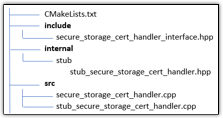
Herde a interface
Crie uma classe concreta que herde a interface. Oculte esse arquivo de cabeçalho e outros arquivos em um diretório separado para que os cabeçalhos privados e públicos possam ser diferenciados facilmente durante a criação.
#ifndef IOTMANAGEDINTEGRATIONSDEVICE_SDK_STUB_SECURE_STORAGE_CERT_HANDLER_HPP
  #define IOTMANAGEDINTEGRATIONSDEVICE_SDK_STUB_SECURE_STORAGE_CERT_HANDLER_HPP

  #include "secure_storage_cert_handler_interface.hpp"

  namespace IoTManagedIntegrationsDevice::CertHandler {
    class StubSecureStorageCertHandler : public SecureStorageCertHandlerInterface {
      public:
        StubSecureStorageCertHandler() = default;

        bool read_cert_and_private_key(const CERT_TYPE_T cert_type,
                                      std::string &cert_value,
                                      std::string &private_key_value) override;

        bool write_permanent_cert_and_private_key(
            std::string_view cert_value, std::string_view private_key_value) override;
            /*
            * any other resource for function you might need
            */


          };
      }
    #endif //IOTMANAGEDINTEGRATIONSDEVICE_SDK_STUB_SECURE_STORAGE_CERT_HANDLER_HPP
Implementação
Implemente a classe de armazenamento definida acima,src/stub_secure_storage_cert_handler.cpp.
/*
  * Copyright 2024 Amazon.com, Inc. or its affiliates. All rights reserved.
  *
  * AMAZON PROPRIETARY/CONFIDENTIAL
  *
  * You may not use this file except in compliance with the terms and
  * conditions set forth in the accompanying LICENSE.txt file.
  *
  * THESE MATERIALS ARE PROVIDED ON AN "AS IS" BASIS. AMAZON SPECIFICALLY
  * DISCLAIMS, WITH RESPECT TO THESE MATERIALS, ALL WARRANTIES, EXPRESS,
  * IMPLIED, OR STATUTORY, INCLUDING THE IMPLIED WARRANTIES OF MERCHANTABILITY,
  * FITNESS FOR A PARTICULAR PURPOSE, AND NON-INFRINGEMENT.
  */

  #include "stub_secure_storage_cert_handler.hpp"

  using namespace IoTManagedIntegrationsDevice::CertHandler;

  bool StubSecureStorageCertHandler::write_permanent_cert_and_private_key(
              std::string_view cert_value, std::string_view private_key_value) {
            // TODO: implement write function
            return true;
  }

  bool StubSecureStorageCertHandler::read_cert_and_private_key(const CERT_TYPE_T cert_type,
                                                          std::string &cert_value,
                                                          std::string &private_key_value) {
          std::cout<<"Using Stub Secure Storage Cert Handler, returning dummy values";
          cert_value = "StubCertVal";
          private_key_value = "StubKeyVal";
          // TODO: implement read function
          return true;
  }
Implemente a função de fábrica definida na interface,src/secure_storage_cert_handler.cpp.
#include "stub_secure_storage_cert_handler.hpp"

        std::shared_ptr<IoTManagedIntegrationsDevice::CertHandler::SecureStorageCertHandlerInterface>
        IoTManagedIntegrationsDevice::CertHandler::createSecureStorageCertHandler() {
          // TODO: replace with your implementation
        return std::make_shared<IoTManagedIntegrationsDevice::CertHandler::StubSecureStorageCertHandler>();
      }
CMakeList.txt
#project name must stay the same
      project(SecureStorageCertHandler)

      # Public Header files. The interface definition must be in top level with exactly the same name
      #ie. Not in anotherDir/secure_storage_cert_hander_interface.hpp
      set(PUBLIC_HEADERS
                ${PROJECT_SOURCE_DIR}/include
      )

      # private implementation headers.
      set(PRIVATE_HEADERS
                ${PROJECT_SOURCE_DIR}/internal/stub
      )

      #set all sources
      set(SOURCES
                ${PROJECT_SOURCE_DIR}/src/secure_storage_cert_handler.cpp
                ${PROJECT_SOURCE_DIR}/src/stub_secure_storage_cert_handler.cpp
        )

      # Create the shared library
      add_library(${PROJECT_NAME} SHARED ${SOURCES})
      target_include_directories(
                ${PROJECT_NAME}
                PUBLIC
                    ${PUBLIC_HEADERS}
                PRIVATE
                    ${PRIVATE_HEADERS}
      )

      # Set the library output location. Location can be customized but version must stay the same
      set_target_properties(${PROJECT_NAME} PROPERTIES
                LIBRARY_OUTPUT_DIRECTORY ${CMAKE_BINARY_DIR}/../lib
                VERSION 1.0
                SOVERSION 1
      )

      # Install rules
      install(TARGETS ${PROJECT_NAME}
                LIBRARY DESTINATION lib
                ARCHIVE DESTINATION lib
      )

      install(FILES ${HEADERS}
                DESTINATION include/SecureStorageCertHandler
      )
Uso
Após a compilação, você terá um arquivo de biblioteca de objetos libSecureStorageCertHandler.so compartilhados e seus links simbólicos associados. Copie o arquivo da biblioteca e os links simbólicos para a localização da biblioteca esperada pelo HubOnboarding binário.
Considerações importantes
-
Verifique se sua conta de usuário tem permissões de leitura e gravação para o HubOnboarding binário e a
libSecureStorageCertHandler.sobiblioteca. -
Mantenha
secure_storage_cert_handler_interface.hppcomo seu único arquivo de cabeçalho público. Todos os outros arquivos de cabeçalho devem permanecer em sua implementação privada. -
Verifique o nome da sua biblioteca de objetos compartilhados. Enquanto você cria
libSecureStorageCertHandler.so, HubOnboarding pode exigir uma versão específica no nome do arquivo, como.libSecureStorageCertHandler.so.1.0Use olddcomando para verificar as dependências da biblioteca e criar links simbólicos conforme necessário. -
Se sua implementação da biblioteca compartilhada tiver dependências externas, armazene-as em um diretório que HubOnboarding possa ser acessado, como
/usr/lib or the iotmi_commondiretório.
Use armazenamento seguro
Atualize seu iotmi_config.json arquivo configurando iot_claim_cert_path e iot_claim_pk_path paraSECURE_STORAGE.
{
  "ro": {
    "iot_provisioning_method": "FLEET_PROVISIONING",
    "iot_claim_cert_path": "SECURE_STORAGE",
    "iot_claim_pk_path": "SECURE_STORAGE",
    "fp_template_name": "device-integration-example",
    "iot_endpoint_url": "[ACCOUNT-PREFIX]-ats.iot.AWS-REGION.amazonaws.com",
    "SN": "1234567890",
    "UPC": "1234567890"
  },
  "rw": {
    "iot_provisioning_state": "NOT_PROVISIONED"
  }
}
