Using hybrid post-quantum TLS
AWS Payment Cryptography and many other services supports a hybrid post-quantum key exchange option for the Transport Layer Security (TLS) network encryption protocol. You can use this TLS option when you connect to API endpoints or when using the AWS SDKs. These optional hybrid post-quantum key exchange features are at least as secure as the TLS encryption we use today and are likely to provide additional long-term security benefits.
The data that you send to enabled services is protected in transit by the encryption provided by a Transport Layer Security (TLS) connection. The classic cipher suites based on RSA and ECC that AWS Payment Cryptography supports for TLS sessions make brute force attacks on the key exchange mechanisms infeasible with current technology. However, if large scale or cryptographically relevant quantum computers (CRQC) becomes practical in the future, the existing TLS key exchange mechanisms will be susceptible to these attacks. It is possible that adversaries may begin harvesting encrypted data now with the hope that they can decrypt it in the future (harvest now, decrypt later). If you’re developing applications that rely on the long-term confidentiality of the data passed over a TLS connection, you should consider a plan to migrate to post-quantum cryptography before large-scale quantum computers become available for use. AWS is working to prepare for this future, and we want you to be well-prepared, too.
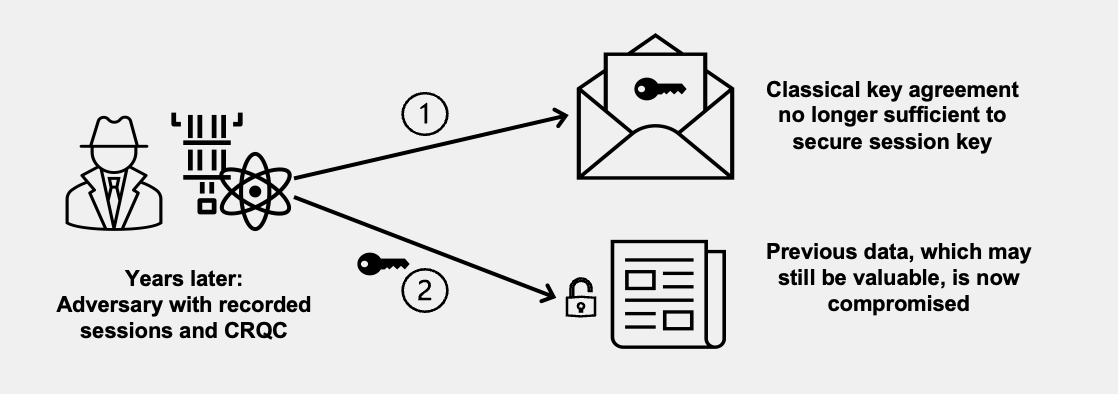
To protect data encrypted today against potential future attacks, AWS is participating with the cryptographic community in the development of quantum-resistant or post-quantum algorithms. AWS has implemented hybrid post-quantum key exchange cipher suites that combine classic and post-quantum elements to ensure that your TLS connection is at least as strong as it would be with classic cipher suites.
These hybrid cipher suites are available for use on your production workloads when using recent versions of the AWS SDKs. For more information about how to enable/disable this behavior, please see Enabling hybrid post-quantum TLS.

About hybrid post-quantum key exchange in TLS
The algorithms that AWS uses are a hybrid that combines Elliptic Curve
Diffie-Hellman
How to use it
For information about enabling hybrid post-quantum TLS in the AWS SDKs, see Enabling hybrid post-quantum TLS.
Learn more about PQC
For information about the post-quantum cryptography project at the National Institute
for Standards and Technology (NIST), see Post-Quantum
Cryptography
For information about NIST post-quantum cryptography standardization, see Post-Quantum Cryptography Standardization
